
Identification
Date 5/15/2024
Location Online Turkey
Platform Social Media | X
Perpetrator
Name Ali Yerlikaya
Profession Politician
Position Minister of Interior
Organization Government
Target Group
Targeted Group Gülen Movement
Description The Hizmet (Gülen) Movement is a civil society movement that operates in the fields of education, dialogue, and humanitarian aid, rejects violence, and is based on voluntary participation. The movement places universal values such as respect for human rights, the rule of law, pluralism, and peaceful coexistence at its core, and regards religious, cultural, and social diversity as a source of richness.
Targeted Individuals (If any)
Content of the incident
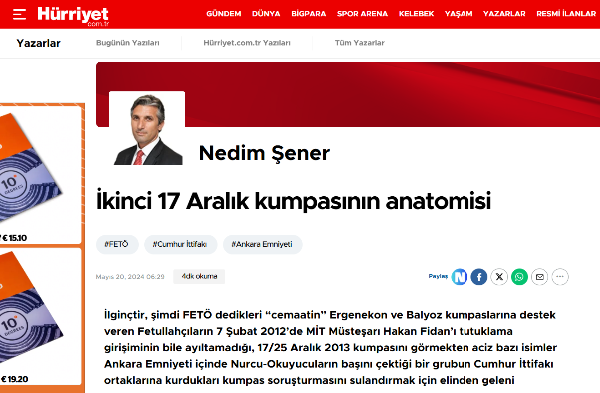
Summary The text reproduces and discusses a series of political claims and institutional allegations concerning policing and judicial processes, and includes a quoted statement attributed to the Minister of Interior. Within that quoted statement, the term “FETÖ” is used to characterize alleged “tactics” and to frame unnamed actors as acting with terrorist organizations and their extensions against political leadership. The content appears in a written, commentary-style format.
Quotation TR: “Kimler, terör örgütleri ve onların uzantılarıyla, organize suç örgütleriyle bir olup FETÖ taktikleriyle Sayın Cumhurbaşkanımıza, hükümetimize ve siyasilerimize, sosyal medya destekli ‘oyun kurmaya’ çalışıyorsa, onların oyunlarını da kurdukları tuzakları da yerle bir edeceğiz”
EN: “Whoever is trying to ‘set up a game’—supported by social media—against our President, our government, and our politicians by joining forces with terrorist organizations and their extensions, and with organized crime groups, using FETÖ tactics, we will crush both their games and the traps they have set.”
Context The term “FETÖ” is a politically charged label that was produced and widely disseminated through state discourse in Türkiye after 2016, without a clearly defined legal basis. By grouping all individuals and entities associated with the Gülen Movement under a single, homogeneous category of “terrorism,” the term eliminates the principle of individual criminal responsibility and creates a framework of collective guilt.
From the perspective of international human rights law, the criminalization of a community on the basis of alleged ideological or religious affiliation, without individualized judicial determination, is incompatible with the presumption of innocence, freedom of expression, and the prohibition of discrimination. In this context, the term “FETÖ” functions not merely as a descriptive label, but as a stigmatizing and targeting form of rhetoric.
The systematic use of the term in media, political, and public discourse contributes to portraying individuals associated with the Gülen Movement as security threats, facilitates their dehumanization, and exposes them to social hostility. For these reasons, when used irrespective of context, the term “FETÖ” constitutes a slur that meets the criteria of hate speech and discriminatory language.
Language of expression Turkish
Source Link https://x.com/AliYerlikaya/status/1790635642168250458?s=20
Images HS-202602-004/HS-202602-004.Source_Screenshot.093204.png
Why this case qualifies as hate speech?
Context Description The term “FETÖ” is a politically charged label that was produced and widely disseminated through state discourse in Türkiye after 2016, without a clearly defined legal basis. By grouping all individuals and entities associated with the Gülen Movement under a single, homogeneous category of “terrorism,” the term eliminates the principle of individual criminal responsibility and creates a framework of collective guilt.
From the perspective of international human rights law, the criminalization of a community on the basis of alleged ideological or religious affiliation, without individualized judicial determination, is incompatible with the presumption of innocence, freedom of expression, and the prohibition of discrimination. In this context, the term “FETÖ” functions not merely as a descriptive label, but as a stigmatizing and targeting form of rhetoric.
The systematic use of the term in media, political, and public discourse contributes to portraying individuals associated with the Gülen Movement as security threats, facilitates their dehumanization, and exposes them to social hostility. For these reasons, when used irrespective of context, the term “FETÖ” constitutes a slur that meets the criteria of hate speech and discriminatory language.
Contextual Analysis The quoted expression uses the term “FETÖ” as a generalized label and associates the referenced actors with “terrorist organizations and their extensions” and “organized crime organizations,” thereby attributing collective criminality and framing an alleged affiliated group as an inherent security threat. The formulation does not address specific, individualized criminal conduct with individualized responsibility; rather, it relies on stigmatizing group-based characterization and a security-threat framing.
Under ICCPR Article 19 and ECHR Article 10, political expression enjoys strong protection, including robust criticism of institutions and officials; however, such protection is not unlimited. Where expression moves from legitimate criticism into group-based stigmatization that promotes hostility toward a community, restrictions may be justified, particularly in light of ICCPR Article 20(2), which requires prohibition of advocacy of national, racial, or religious hatred that constitutes incitement to discrimination, hostility, or violence. In this instance, the quoted wording supports a stigmatizing, collective criminality framing through the use of “FETÖ” in connection with terrorism and criminality, thereby meeting the hate speech threshold under the stated monitoring standard, even though it does not contain an explicit call for violence.
Classification
Targeted Characteristic Ideological views
Stereotyping true
Insult true
Dehumanization false
Call For Violence false
Discriminatory Policy false
Impact
Stigmatization true
Normalization false
Social Exclusion false
Harassment Risk false
Chilling Effect false
Hostile Environment true
Intergenerational Harm false
 Home
Home Hate Monitoring Records
 Informations – Documents
  Report a Violation
 About Us