
Identification
Date 5/20/2024
Location Online Turkey
Platform Newspaper (Online, Printed) | Hürriyet
Perpetrator
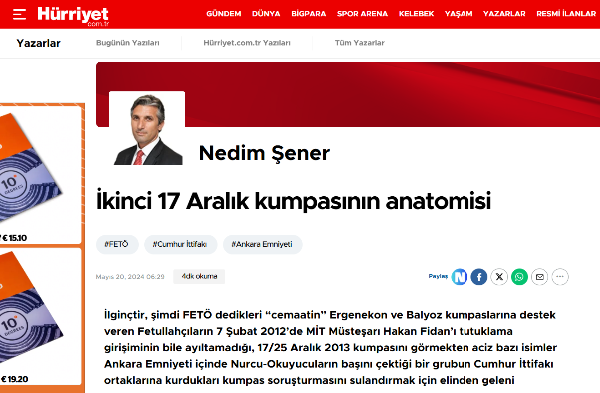
Name Nedim Şener
Profession Journalist
Position Columnist
Organization Hürriyet
Target Group
Targeted Group Gülen Movement
Description The Hizmet (Gülen) Movement is a civil society movement that operates in the fields of education, dialogue, and humanitarian aid, rejects violence, and is based on voluntary participation. The movement places universal values such as respect for human rights, the rule of law, pluralism, and peaceful coexistence at its core, and regards religious, cultural, and social diversity as a source of richness.
Targeted Individuals (If any) Cevheri Güven
Content of the incident
Summary The text alleges that some actors ignore an asserted “FETÖ connection” and refers to multiple religious or social groups in the context of alleged “kumpas” (conspiracy). It further states that a police officer allegedly sent a statement to “fugitive FETÖ member Cevheri Güven,” and describes Güven as “FETÖ’cü,” while also alleging that an individual named Erk Acarer is close to “FETÖ’cüler” and has fled due to arrest warrants. The statements are presented in a written narrative format and repeatedly use “FETÖ” as a stigmatizing label.
Quotation TR: “Bazıları, gözünün önündeki ‘FETÖ bağlantısına’ gözünü kapamayı tercih ediyor.”
“Narkotik Şube’de görevli bir polis memurunun Kaplan’ın ifadesini firari FETÖ mensubu Cevheri Güven’e yolladığı belirlenmişti.”
“FETÖ’cü Güven ve FETÖ’cülerle yakın çalışan…”
EN: “Some people choose to turn a blind eye to the ‘FETÖ connection’ right in front of them.”
“It had been determined that a police officer working in the Narcotics Unit sent Kaplan’s statement to Cevheri Güven, a fugitive member of FETÖ.”
“Güven, who is FETÖ-affiliated, people, who works closely with FETÖ members…”
Context The term “FETÖ” is a politically charged label that was produced and widely disseminated through state discourse in Türkiye after 2016, without a clearly defined legal basis. By grouping all individuals and entities associated with the Gülen Movement under a single, homogeneous category of “terrorism,” the term eliminates the principle of individual criminal responsibility and creates a framework of collective guilt.
From the perspective of international human rights law, the criminalization of a community on the basis of alleged ideological or religious affiliation, without individualized judicial determination, is incompatible with the presumption of innocence, freedom of expression, and the prohibition of discrimination. In this context, the term “FETÖ” functions not merely as a descriptive label, but as a stigmatizing and targeting form of rhetoric.
The systematic use of the term in media, political, and public discourse contributes to portraying individuals associated with the Gülen Movement as security threats, facilitates their dehumanization, and exposes them to social hostility. For these reasons, when used irrespective of context, the term “FETÖ” constitutes a slur that meets the criteria of hate speech and discriminatory language.
Language of expression Turkish
Source Link https://www.hurriyet.com.tr/yazarlar/nedim-sener/ikinci-17-aralik-kumpasinin-anatomisi-42464337
Images HS-202602-005/HS-202602-005.Source_Screenshot.094457.png
Why this case qualifies as hate speech?
Context Description The term “FETÖ” is a politically charged label that was produced and widely disseminated through state discourse in Türkiye after 2016, without a clearly defined legal basis. By grouping all individuals and entities associated with the Gülen Movement under a single, homogeneous category of “terrorism,” the term eliminates the principle of individual criminal responsibility and creates a framework of collective guilt.
From the perspective of international human rights law, the criminalization of a community on the basis of alleged ideological or religious affiliation, without individualized judicial determination, is incompatible with the presumption of innocence, freedom of expression, and the prohibition of discrimination. In this context, the term “FETÖ” functions not merely as a descriptive label, but as a stigmatizing and targeting form of rhetoric.
The systematic use of the term in media, political, and public discourse contributes to portraying individuals associated with the Gülen Movement as security threats, facilitates their dehumanization, and exposes them to social hostility. For these reasons, when used irrespective of context, the term “FETÖ” constitutes a slur that meets the criteria of hate speech and discriminatory language.
Contextual Analysis The expression repeatedly uses “FETÖ” and derivative forms (“FETÖ’cü,” “FETÖ mensubu,” “FETÖ bağlantısı”) to stigmatize and criminalize, including by attributing “FETÖ” affiliation to named individuals and by implying an underlying, pervasive “connection” that others allegedly ignore. However, the quoted wording primarily asserts criminal association and wrongdoing as allegations about specific persons and alleged networks, rather than articulating a broad call to discriminate against, exclude, or harm a protected group, or clearly dehumanizing the group as such.
Under ICCPR Article 19 and ECHR Article 10, commentary on alleged criminality and public-interest matters may be protected; nevertheless, the use of the term “FETÖ” as a generalized stigmatizing label risks collapsing individual responsibility into collective guilt and may contribute to hostility toward persons perceived as associated with the Gülen Movement. In this excerpt, while the rhetoric is stigmatizing and employs a slur-like label, it does not clearly cross into advocacy of hatred constituting incitement to discrimination, hostility, or violence under ICCPR Article 20(2) based solely on the provided wording. The expression, while potentially controversial or politically charged, does not meet the threshold of hate speech under international human rights standards.
Classification
Targeted Characteristic Ideological views
Stereotyping true
Insult true
Dehumanization false
Call For Violence false
Discriminatory Policy false
Impact
Stigmatization true
Normalization false
Social Exclusion false
Harassment Risk false
Chilling Effect true
Hostile Environment false
Intergenerational Harm false
 Home
Home Hate Monitoring Records
 Informations – Documents
  Report a Violation
 About Us